
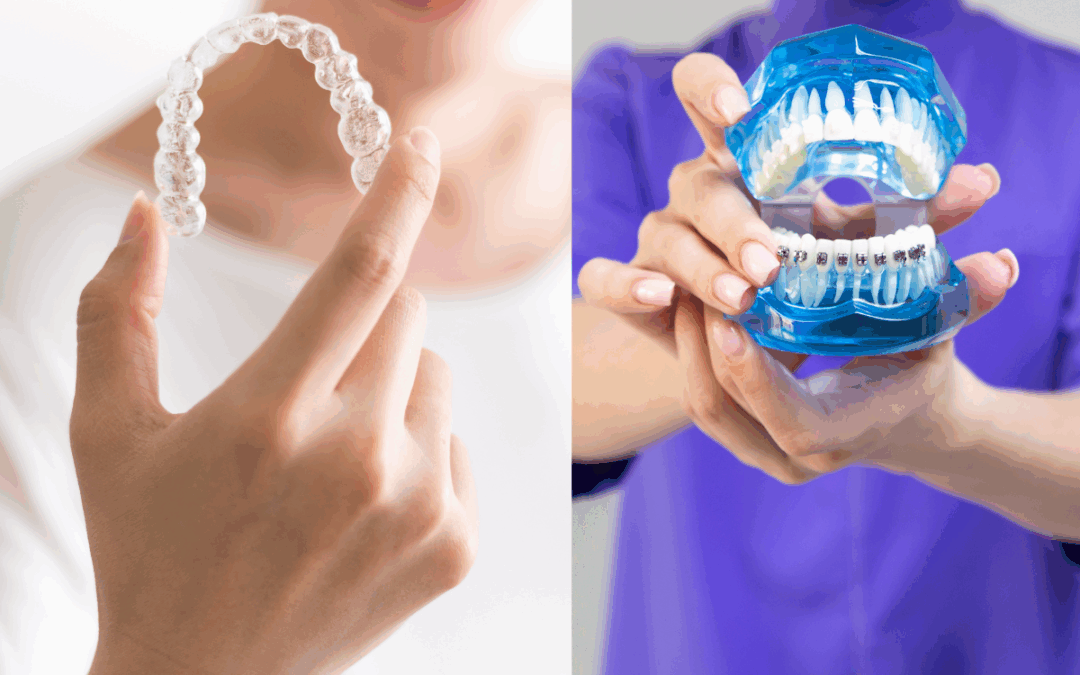
Clear aligners vs Braces: Which is best for orthodontics in San Antonio, TX? With so many options, choosing between clear aligners and braces can be difficult.
The difference between clear aligners and braces lies in their appearance, comfort, maintenance, and cost. As an orthodontist in San Antonio, we have covered the significant differences between clear aligners vs. braces in detail in this article. Understand clear braces vs aligners for adults and teens, their pros and cons, and treatment timelines. Furthermore, this will also highlight how clear aligner braces compare to metal braces in terms of everyday life, treatment outcomes, and long-term value.
What is Clear Aligner?
Clear aligners are a modern orthodontic system compared to braces. Clear aligner braces use a series of clear aligners—custom-fitted trays that gradually move your teeth into the desired position. Each set is worn for 1–2 weeks before moving on to the next in the sequence. Clear aligners in orthodontics are removable, virtually invisible, and made from BPA-free SmartTrack® material designed for comfort and efficient movement.
When people talk about clear aligner dental treatment, they’re usually referring to:
- Clear aligners, a clear aligner system, are designed to align teeth without metal brackets or wires.
- A flexible, lifestyle-friendly approach to straightening teeth.
- A treatment plan fully customized by an orthodontist using 3D scans and digital mapping.
What Are Braces?
In comparison to clear aligners, braces are the time-tested solution in orthodontics. Traditional braces are constructed with metal or ceramic brackets bonded to the teeth and connected by wires. Similar to clear aligners, these also gradually tighten to shift the teeth into their desired position. Traditional braces are ideal for treating a wide range of orthodontic concerns – from mild crowding to complex bite misalignments.
Clear Aligners vs Traditional Braces: The Key Differences
| Category | Clear Aligners Braces | Traditional Braces |
| Visibility | Clear aligners are transparent and barely noticeable. | Braces are visible, even when using clear or ceramic brackets. |
| Removability | Clear aligners can be removed for eating, brushing, and flossing. | Braces are fixed to the teeth and cannot be removed until the treatment is complete. |
| Diet Restrictions | Clear aligner dental patients can eat any food—remove the trays beforehand. | Sticky, crunchy, and hard foods must be avoided to prevent damage to brackets. |
| Oral Hygiene | Brushing and flossing are easier with clear aligners—no brackets to work around. | Requires extra care to clean around wires and brackets, increasing effort. |
Appearance: Clear Aligners vs. Braces
For many patients, especially adults and self-conscious teens, the most significant appeal of clear aligner dental braces is their discretion. These clear dental braces for adults are hardly noticeable in everyday interactions. They offer a polished, professional look without the metallic shine of traditional braces.
While ceramic braces offer a lower-profile alternative to metal braces, they still utilize brackets and wires. For patients who want orthodontic treatment to be as unnoticeable as possible, clear aligners have the upper hand.
Comfort and Lifestyle: Clear Aligners vs. Braces?
Orthodontic treatment with clear dental braces for adults often offers a smoother and more comfortable experience. The aligners are custom-molded to your mouth and don’t irritate the gums and cheeks like wires sometimes do.
Lifestyle-wise:
- Braces require more adjustments and may cause temporary discomfort after tightening.
- Clear aligners for teeth are removable, so you can eat, brush, and floss like normal.
- Clear aligners also allow you to play sports and musical instruments more comfortably.
So when asking, “Is Clear Aligner better than braces in terms of comfort?”—for many, the answer is yes.
Convenience and Maintenance
Maintaining oral hygiene is much simpler with clear aligners:
- Remove aligners to brush and floss thoroughly.
- No special tools (like floss threaders or interdental brushes) are needed.
- You can clean the aligners with cleaning crystals or a mild soap and water solution.
In contrast, braces require meticulous hygiene around brackets and wires. Improper cleaning can lead to plaque buildup, gum irritation, and even white spots on enamel.
Treatment Effectiveness: Can Both Achieve Your Dream Smile?
One of the most common concerns is, “Is Clear Aligner more effective than braces?” The short answer is, “It depends.”
- Braces remain the gold standard for complex orthodontic cases, such as:
- Severe crowding
- Major bite corrections
- Teeth that need to be rotated significantly
- Clear aligners are incredibly effective for mild to moderate misalignment, spacing issues, and simple bite corrections.
At Oliver Family Orthodontics, we offer comprehensive evaluations to determine which method will give you the best, most predictable results. For many patients, clear aligner treatment is as effective as braces when properly supervised by an orthodontist.
Treatment Duration: How Long Will My Journey Be?
Patients often ask about how long treatment will take. Here’s a general overview:
- Clear Aligners: 12 to 18 months on average (for mild to moderate cases).
- Braces: 18 to 24 months (depending on complexity).
However, every patient is different. One advantage of clear aligner dental treatment is the ability to visualize the entire treatment plan through digital modeling, which helps set realistic expectations from day one.
Making Your Choice: Traditional vs Clear Aligner Orthodontics?
Choosing between clear aligner orthodontic braces or traditional braces depends on your goals, preferences, and orthodontic needs.
Clear aligners may be the better choice if you:
- Want a discreet appearance.
- Have mild to moderate alignment issues.
- Can commit to wearing the aligners 20–22 hours per day.
- Prefer fewer dietary restrictions and easier cleaning.
Braces may be a better fit if you:
- Have severe misalignment or bite issues.
- Prefer not to worry about removable trays.
- Need guaranteed compliance (especially for younger patients).
Clear Aligner vs Braces: Orthodontic Treatment Comparison For Adults and Teenagers
Clear Aligner vs. Metal Braces – Which is Best for Adults?
Adults often prefer clear aligner treatment due to its discreet appearance and the flexibility it offers for daily life. Whether you’re attending professional meetings, social events, or simply want to avoid the visibility of metal brackets, clear aligners for teeth provide a subtle and convenient solution.
Key benefits of clear aligner orthodontic treatment for adults include:
- Aesthetic appeal: A clear aligner system is virtually invisible, making it ideal for those who value a natural smile during treatment.
- Removability: Adults appreciate being able to remove aligners for meals, photos, and oral hygiene, which is an advantage over fixed braces.
- Minimal lifestyle disruption: No food restrictions, easier brushing and flossing, and fewer emergency visits (such as wire pokes or broken brackets).
From a technical standpoint, many adult cases involve mild to moderate crowding, spacing, or relapse from prior orthodontic treatment—issues that are highly compatible with clear dental braces treatment. Digital planning software used in orthodontics, clear aligner orthodontic treatment, enables precise tooth movement simulations, giving adult patients a clear timeline and predictable results.
However, adults with complex malocclusions such as severe overbites, underbites, or dental rotations may benefit more from traditional braces, which offer more controlled and forceful movements with the use of auxiliary appliances like elastics or TADs (temporary anchorage devices). This makes the decision between dental braces vs clear aligners a highly individualized one.
Clear Aligners vs. Braces for Teenagers
Teenagers today have more orthodontic options than ever before—including clear aligners for Teen, a version of aligners designed explicitly for growing mouths. While both braces and clear aligners can be highly effective, specific considerations are unique to this age group.
Clear Aligners Teen includes:
- Blue compliance indicators that fade with wear, helping orthodontists and parents ensure teens are wearing the trays as directed (20–22 hours per day).
- Eruption tabs that allow for the developing permanent teeth to come in properly.
- Free replacement aligners (usually up to 6) in case trays are lost or damaged—an essential feature for active, busy teens.
Take the First Step with Oliver Family Orthodontics
Still wondering, “Which is better, braces or clear aligners?” Let’s figure it out together. At Oliver Family Orthodontics – San Antonio, TX, we’re proud to provide expert care tailored to your smile and lifestyle. Choosing between clear aligners vs Braces San Antonio, TX, starts here. Choose clear aligners or traditional braces and start your journey to a healthier, straighter smile.
Schedule a consultation and find out if clear aligner is right for you, or if braces might be the better fit.
FAQs
Q. Braces or Clear Aligner: Which Option Suits You Best?
A: Braces are typically more effective for complex orthodontic cases, while clear aligners are ideal for mild to moderate misalignments. Clear aligners may be the better choice if you’re looking for a more discreet, removable option that fits seamlessly into your lifestyle.
Q. What are the negatives of clear aligners?
A: Clear aligner requires strict wear time, aren’t ideal for complex cases, and must be removed for eating or drinking. Lost or damaged trays can delay treatment.
Q. Are Clear Aligners as Effective as Traditional Braces?
A: Yes, clear aligners are effective for mild to moderate cases. For complex issues, traditional braces may work better.
Q. Do Dentists Prefer Clear Aligners or Braces?
A: Clear aligners work well for mild to moderate misalignment, but braces are often more effective for severe cases.